 A Lullaby for the Dead
Written by Robert Bruce
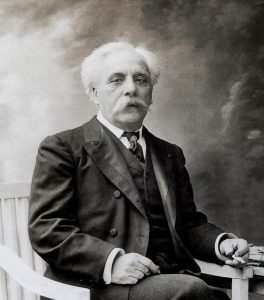
A favorite of both choral singers and concertgoers, Gabriel Fauré’s Requiem had its first performance on May 4, 1888, at La Madeleine in Paris. At that time the work consisted of only five movements, with the composer calling it “un petit Requiem.” Fauré would continue adding to his score and revising it for several years, with the final version being first heard in 1900. Scored for soprano and baritone soloists, mixed chorus, and full orchestra, the final version consists of seven movements, the last of which, the beautiful In Paradisum, is not a part of the Latin Mass for the Dead but belongs rather to the Burial Service.
Although Fauré had lost both his parents in the 1880s, he always claimed that he wrote the Requiem not for them, but “for fun.” The most unusual feature of Fauré’s setting is that he chose to discard the entire Dies irae sequence, which tells of the Last Trumpet and the Day of Judgement for All Souls, interspersed with prayers for salvation. Instead, Fauré chose texts, editing the original and including the Pie Jesu and In Paradisum, which emphasize peace after death. The composer wrote of the work, “Everything I managed to entertain by way of religious illusion I put into my Requiem, which moreover is dominated from beginning to end by a very human feeling of faith in eternal rest.” Perhaps it is this very attitude that has endeared the work to so many for well over a century. Fittingly, the work was performed at the composer’s own funeral in 1924. If you’d like to enjoy a performance of Fauré’s Requiem, please join me for the Saturday Evening Concert on May 21, when I’ll be presenting a program of French music, including Fauré’s choral masterwork.