Charles-Marie Widor and the Organ Symphony
Charles-Marie Widor and the Organ Symphony

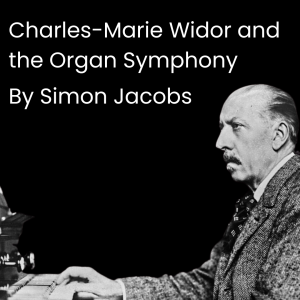 Charles-Marie Widor was one of the most influential French Romantic organist-composers of his time. He was born in 1844 in Lyon to a family of organ builders, and studied organ and composition in Brussels. Widor then settled in Paris, where he remained for the rest of his life. He was a professor at the Paris Conservatoire, and in 1870 was appointed organist at the prestigious Church of Saint-Sulpice, where he remained for the next 63 years.
Widor’s most famous piece of organ music is undoubtedly the blazing Toccata from his Symphony no. 5, which has become a favorite on Easter Sunday in churches around the world. The Toccata, though, represents just a small window into his voluminous output of organ symphonies – Widor wrote ten in total, spanning the years 1870-1900. The symphony as an orchestral form was of course well-established by the end of the nineteenth century, but Widor was the first composer to write similar works for the organ. Widor’s adaptation of the symphony to the instrument was made possible by the development of the French Romantic organ tradition, pioneered by organ builder Aristide Cavaillé-Coll. Organs were now able to emulate a multitude of orchestral colors and timbres, and the organist could affect smooth crescendos and diminuendos, allowing new and exciting expressive possibilities.
Widor’s ten organ symphonies can essentially be divided into three distinct stylistic groups: Symphonies 1 to 4 are more like suites, and represent the early stages of Widor’s career. The composer made many revisions to them in later years. Symphonies 5 through 8 are truly symphonic in scope; they are extensive works with contrasting movements and common themes interwoven throughout. These symphonies are also the most adventurous in their explorations of Cavaillé-Coll’s new Romantic instruments. Finally, Symphonies 9 and 10 are the only ones to have programmatic titles: “Gothique” and “Romane”. These works, written from 1895 to 1900, are more reflective, and incorporate Gregorian Chant as thematic material.
The development of the organ symphony by Charles-Marie Widor was an extremely innovative step in the history of organ music, and set the stage for subsequent composers, in France and beyond, to continue to explore the possibilities of the organ as a one-man orchestra. The Romantic organ-building movement flourished around the world well into the twentieth century, and inspired many great works written for The King of Instruments.