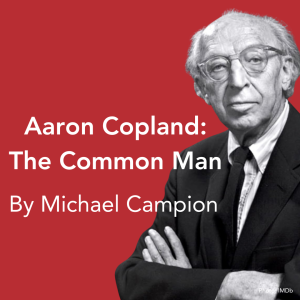
Aaron Copland: The Common Man
Aaron Copland: The Common Man

 In his own words Aaron Copland sought to capture “a music that would speak of universal things in a vernacular of American speech rhythms.” He went on to say, “In order to create an indigenous music of universal significance, three conditions are imperative. First, the composer must be part of a nation that has a profile of its own; second, the composer must have in his background some sense of musical culture, and, if possible, a basis in folk or popular art; and third, a superstructure of organized music activities must exist.”
In trying to capture this style, Copland tried jazz as a means of capturing this rhythmic vitality, but soon turned to American folk music as his basis. The result was a wonderfully original style that was based on melodic and rhythmic aspects of this folk music, but was completely new. Because of this we are immediately struck by the Americanism of his music and the vibrancy of its personality. By far the most popular, and possibly the greatest examples of this kind of music are found in the ballet Appalachian Spring and the orchestral gem Fanfare for the Common Man.
The Fanfare was commissioned by conductor Eugene Goossens for the 1942-43 season of the Cincinnati Symphony Orchestra. Copland, along with nine of his colleagues, was asked to write a fanfare commemorating those who had been giving so much to the war effort. Most of those submitted compositions praised the work of the military and those serving in other capacities overseas. But Copland took a different approach. When he noticed that the piece written by Walter Piston was called Fanfare for the Fighting French, the idea for this famous music came to him. He said, “It seemed to me that if the fighting French got a fanfare, so should the common man. After all, it was he who was doing the dirty work in the war.” He described it as having “a certain nobility of tone, which suggested slow, rather than fast music,” and said that it “honors the man who did no deeds of heroism on the battlefield, but shared the labors, sorrows and hopes of those who strove for victory.”
From its solemn and noble opening discourse on timpani and gong, through its first unison melody and the firm resolve of the brass in full harmony, to its determined climax, the work stands as a testimony to American pride and unwavering resolve.