By: Quinn Riley
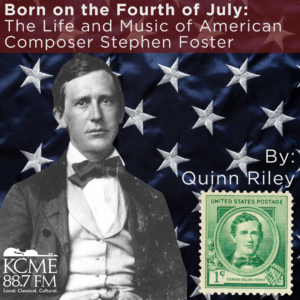 Known as “The Father of American Music,” Stephen Collins Foster was born in Lawrenceville, Pennsylvania on July 4, 1826, during the celebration of America’s 50th birthday. Coincidentally, it was also the same day two of America’s Founding Fathers, John Adams and Thomas Jefferson, passed away.
Though not born into a musical family, Foster showed remarkable musical talent at an early age, by playing tunes on the guitar at 2 years old. At the age of 13, Foster began his first lessons in composition under the tutelage of a German-born musician and music dealer in Pittsburgh named Henry Kleber who exposed Foster to the works of Mozart, Beethoven, Weber, Mendelssohn, and Schubert.
At the age of 20, Foster penned the song “Oh! Susanna,” a tune that would launch his musical career. Though “Oh! Susanna” became associated with blackface minstrel shows, many of Foster’s subsequent songs were increasingly more sensitive to the sufferings of African American slaves, and one song in particular, “My Old Kentucky Home,” was lauded by abolitionist Frederick Douglas as a song that “awakens sympathies for the slave, in which antislavery principles take root, grow, and flourish.” In 1928, “My Old Kentucky Home” officially became the state song of Kentucky and is traditionally played every year before the Kentucky Derby.
In 1846, because he wasn’t making much money as a composer, Foster’s brothers helped him obtain work at the Hope Cotton Mill, where his job consisted of checking cotton bales as they were unloaded from the steamboats. He also worked as a bookkeeper for his brother Dunning’s shipping company. Those jobs lasted a little over three years, until Foster entered into a contract with a New York based music publisher. In 1850, Foster left the shipping and cotton businesses, married Jane Denny McDowell in Pittsburgh, and spent the next five years penning some of his most beloved parlor songs, including “Camptown Races,” “Nelly Bly,” “My Old Kentucky Home,” “Old Dog Tray,” “Jeanie with the Light Brown Hair,” and “Come Where My Love Lies Dreaming.”
In 1860, Foster moved his family to New York City, so he could be closer to the American music publishing business. About a year later, his wife and then 10-year-old daughter left him and returned to Pittsburgh. Subsequently, Foster became very depressed and turned to alcohol for comfort. Washed up and penniless, Foster spent his last years in an alcoholic haze. In January of 1864, while living at the North American Hotel on the Lower East Side of Manhattan, the now impoverished Foster became ill and was confined to his bed. Attempting to get out of bed, Foster fell against a washbasin that shattered upon impact, gouging his head and neck. He was taken to Bellevue Hospital where he died three days later at the age of 37. In Foster’s possession at the time of his death was a worn leather purse containing 35 cents in Civil War scrip, 3 pennies, and a scrap of paper on which he’d penned “Dear friends and gentle hearts.”
Stephen Foster is buried at the Allegheny Cemetery in Pittsburgh’s Lawrenceville neighborhood. To this day, during the first part of July, the Lawrenceville Historical Society co-hosts the annual Stephen Foster Music and Heritage Festival, known as Doo Dah Days!