Lyric Poet of Music by Robert Bruce
Lyric Poet of Music by Robert Bruce

 Franz Schubert was one of the great melodic geniuses in all classical music. Born in Vienna on January 31, 1797, he died there in 1828, at a younger age than any of the great composers. He was also one of the most neglected. During his short life, Schubert wrote eight symphonies, twenty-two piano sonatas, thirty-five chamber works, many short piano pieces, six masses, over six hundred songs and much more, including piano duets, choral music, incidental music, and operas. Yet of this, only one string quartet, three piano sonatas, one mass and less than a third of the songs were published during his lifetime.
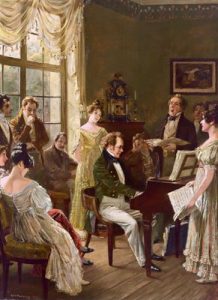
Having received his only musical training while he was a member of the Imperial Choir of Vienna, Schubert began composing at the age of fourteen. He took a teaching position in 1814 but spent most of his time ignoring the students while concentrating on composing. He quit his job in 1817 and never held another. Living a bohemian life as a bachelor, Schubert would rely on the kindness, support, and financial assistance of his close circle of friends for the rest of his life. This group would often gather for literary and musical evenings they called “Schubertiads,” during which they would read through and perform many of Schubert’s scores.
The lyrical element is prevalent in much of Schubert’s music, particularly in the slow movements of larger works and, of course, the songs. Schubert wrote two of his greatest songs while still in his teens, and while his song melodies are always lovely, the composer never neglected the piano part, which over time he treated more and more elaborately. In addition to his great output of German Lieder, outstanding examples of Schubert’s crafting of vocal melody can be heard in the Masses and other choral music, operas and singspiels (brimming with melody but lacking in drama), incidental music and part-songs.
Short, stout (his nickname was “Tubby”), near-sighted, and extremely shy, Schubert began to complain of chronic headaches and back pain in 1823. He suffered for the last five years of his life but never stopped composing the whole time, producing some of his greatest works at this time. Franz Schubert is buried near Beethoven’s grave, and the inscription on his tombstone reads “The Art of Music here entombed a rich possession, but far fairer hopes.”
Please join me for a Saturday Evening Concert “Schubertiad” on January 27 at 8:00, featuring several songs, a string quartet, and the incidental music for “Rosamunde.”