The Greatest Musical Phenomenon Since Mozart
The Greatest Musical Phenomenon Since Mozart

The Greatest Musical Phenomenon Since Mozart
By Fred Kormos
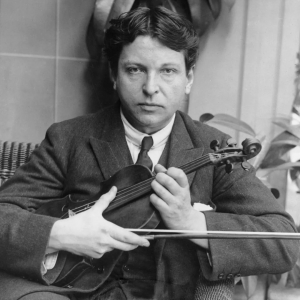
Violinist and conductor Yehudi Menuhin called him “the most extraordinary human being, the greatest musician, and the most formative influence” he had ever experienced. Alfred Cortot, one of the greatest pianists of all time, once said of him that, although he was primarily a violinist, he had better piano technique than his own. And legendary cellist Pablo Casals described him as “one of the greatest geniuses of modern music” and “the greatest musical phenomenon since Mozart.” They were all referring to Romanian composer George Enescu. He was not only a composer, but also a violinist, pianist, conductor, and teacher. A child prodigy, he began composing at the age of five, mostly short pieces for violin and piano. At the age of seven he became the youngest student (and the first non-Austrian) ever admitted to the Vienna Conservatory. He graduated at the age of twelve and then went to Paris to study for four more years at the Paris Conservatory. He subsequently lived in Paris and in Romania, but after World War II and the Soviet occupation of Romania, he remained in Paris where he called himself Georges Enesco.
In 1923, Enescu made his American debut as a conductor with the Philadelphia Orchestra in a concert at Carnegie Hall in New York City. He subsequently visited the United States many times and conducted numerous American orchestras. It was in the U.S. that he made his first recordings as a violinist. In 1936, when Arturo Toscanini stepped down as principal conductor of the New York Philharmonic, Enescu was one of the candidates considered to replace him.
Many of Enescu’s compositions were influenced by Romanian folk music. The Romanian Poem for orchestra and chorus, his first published work, was performed in Paris in 1898 when he was just sixteen years old. His most popular works are the two Romanian Rhapsodies, composed in 1901 and published together as his opus 11.
Enescu was born on August 19th in 1881. This Friday, on his birthday, Enescu’s music will be featured on Back in the Day at 6:00 pm. Tune in and you’ll hear all three of the above-mentioned works, with Enescu himself conducting his two Romanian Rhapsodies! I hope you can join me as I honor George Enescu, “the greatest musical phenomenon since Mozart.”