J.S. Bach's Name in Musical Compositions
J.S. Bach’s Name in Musical Compositions

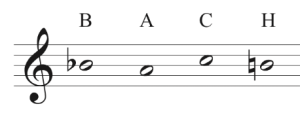
The works of the great Johann Sebastian Bach influenced subsequent composers in diverse ways, and many were so enamored by the work of the great Baroque master that they even translated Bach’s last name into musical notation to create a motif for their compositions.
Looking at the notes above some clarification is needed. It is important to know that the notes B-A-C-H are notated in their German form, with B being B flat, A and C being the same as their English equivalents, and H being B natural in German. Musically these notes are very close together, and their effect when used in a composition is something a little foreboding, other-worldly, and mysterious.
There are quite a few examples of compositions using this musical cryptogram, and there is evidence that Bach himself incorporated his own name into a few of his works. Some examples of nineteenth century works using the BACH motif include Sechs Fugen über den Namen: BACH by Schumann; the Fantasy and Fugue on the Theme B-A-C-H by Liszt; and the Fugue in A-flat minor by Brahms.
When experiments with non-tonal music came along in the early twentieth century, composers such as Arnold Schoenberg, Anton Webern, and Alfred Schnittke found that the BACH motif was excellently suited to the avant-garde.
Clearly, the legacy of J. S. Bach — through not just his music but his very name — has endured to the present day. I invite you to join me for Bach and Sons every Tuesday at noon on KCME, where you’ll occasionally hear some of these subsequent works using the BACH motif.