By Pam DeVier
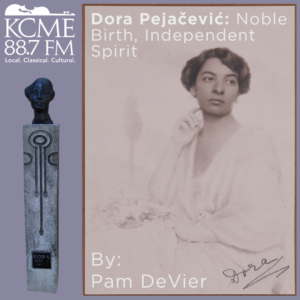
“I simply cannot understand how people can live without work, and how many of them do, especially the higher aristocracy… I despise them because of this.” – Dora Pejačević, from a letter to her friend, Baroness Rosa Lumbe-Mladota, written during or immediately after World War I. (Pejačević spent the war working directly on the front lines as a voluntary nurse tending to wounded soldiers.)
Born into one of Croatia’s oldest noble families, Dora Pejačević (pronounced PEH-yah-cheh-vich) spent her life quietly pushing against the confines of privilege. While others expected her to host salons and uphold aristocratic tradition, she pursued her artistic passions, writing music and becoming one of the first modern orchestral composers from Croatia. Although she only lived for thirty-seven years, she helped bridge the lush emotional language of late Romanticism with the emerging musical ideas of the twentieth century. Her music has remarkable emotional depth and sincerity. It is lyrical without sentimentality, richly scored without excess, and full of her unmistakable introspective voice. While many composers sought spectacle, Pejačević sought emotional truth.
Dora Pejačević was born on September 10, 1885 in Budapest to the distinguished Croatian Pejačević family and spent much of her life at the family estate in Našice, in present-day Croatia. She studied piano, violin, and composition primarily through private instruction, developing her gifts without formal conservatory training. An avid reader, she immersed herself in literature and philosophy, corresponding with writers and thinkers while cultivating an interest in contemporary artistic movements. Although surrounded by aristocratic society, she preferred the company of artists and intellectuals and rejected many of the expectations placed upon women of her class.
Between 1903 and her death in 1923, Pejačević composed fifty-eight works – piano music, chamber music, songs, orchestral works, and one symphony. Her Piano Concerto in G minor and Symphony in F-sharp minor are now among the best-known Croatian orchestral works in the international repertoire. My personal favorite is her Piano Quintet in B minor, a sweeping work that shows her incredible gift for chamber music.
The First World War profoundly affected Pejačević. Working as a volunteer nurse, she witnessed suffering firsthand, an experience that deeply impacted the emotional character of her later music. In 1921 she married Austrian army officer Ottomar von Lumbe. Following the birth of her son on January 4, 1923, she developed complications from childbirth and died on March 5. Her final letters reveal curiosity, intelligence, humility, and a hope that her music would outlive her while questioning the value of social status and worldly ambition.
For decades after her death, Pejačević’s music remained largely overlooked outside her homeland. She occupies an important place in musical history, not because she was a woman composer or a Croatian composer, but because she wrote music of incredible craftsmanship and emotional honesty.
“When I’m floating off into this invisible world of my most personal and inner thoughts, only then do I become my real self.” – from Pejačević’s personal diary
In coming days on KCME, listen for her Symphony in F-sharp minor, Piano Concerto in G minor, Phantasie concertante in D minor, Piano Quintet in B minor, Cello Sonata Op. 35 and Violin Sonatas Op. 26 “Spring” and Op. 43 “Slavic.”