Franz Liszt: An Advocate for the Art of Music
Franz Liszt: An Advocate for the Art of Music

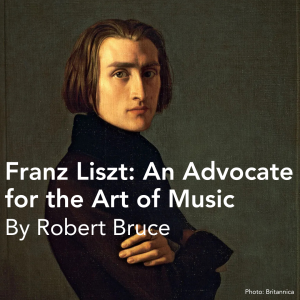 Born in a small town in Hungary on October 22, 1811, Franz Liszt would spend his long life and career assuming various guises – pianist, wanderer, showman, teacher, philanthropist, conductor, and composer. Having applied himself to practicing in order to become what many musicians consider to be the greatest pianist in history, Liszt would spend years traveling abroad dazzling audiences with his incredible technique. During this period, Liszt wrote a tremendous amount of piano music of prodigious difficulty, including a series of pieces based on or derived from the music of other composers, variously called fantasies, paraphrases, or reminiscences, very often with the intention of bringing that music to a wider audience. Liszt was aware of how difficult it was for a young composer to make a name for himself, and from the start did what he could to help familiarize his public with the music of such composers as Schubert, Donizetti, Bellini, Verdi, Auber, Meyerbeer, and Wagner.
One of Liszt’s innovations in giving his piano recitals (a term he coined himself) was the positioning of the piano horizontally on the stage, thereby giving his audience of mostly young ladies a splendid view of his handsome profile and luxurious mane of long, dark hair. It is reported that women swooned at his appearances, and the case could be made that Liszt was in his time what we would today call a “pop star.” During these years of travel and concertizing, Liszt made an enormous amount of money, and began making a practice of giving away much of his proceeds to charities and humanitarian causes. He was a proud and devoted Hungarian nationalist, which resulted in his series of Hungarian Rhapsodies and much other music in a nationalistic style. In 1875 he founded The Hungarian Academy of Music, which has since been relocated to Budapest and is now named after the composer.
In 1848 Liszt gave up his life of wandering and settled in Weimar, Germany, where he had been appointed director of the court orchestra, remaining there until 1861. It was during this period that Liszt concentrated on writing a series of symphonic poems, a genre he is usually credited with having invented. These single-movement orchestral works are always based on some extra-musical idea, be it a painting, poem, story, fictional character, place, or some other source. In addition to his conducting and promoting many works by young and untried composers, Liszt also taught piano privately, instilling his unfettered, improvisational, and utterly romantic style of playing and performing in a new generation of pianists, with a direct line to the 20th century that included the likes of Jorge Bolet and Georges Cziffra.
During KCME’s upcoming Fall Fund Drive, we will be celebrating Franz Liszt’s life, music, and achievements on his birthday, Tuesday, October 22. I hope you can join us!