Francis Poulenc’s La voix humaine (The Human Voice)

Francis Poulenc’s La voix humaine (The Human Voice)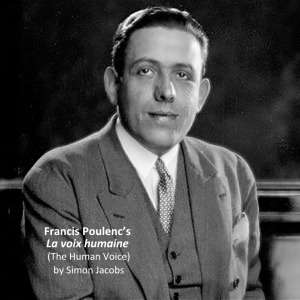
by Simon Jacobs
Francis Poulenc was one of the most influential composers of twentieth-century France, and wrote in many genres, from choral to orchestral. He only started composing opera, though, in the latter half of his career, with his first being the comic opera Les Mamelles de Tirésias (The Breasts of Tiresias), which premiered in 1947.
The remarkable one-act opera, La voix humaine, came a little later in 1958. It’s a tragédie lyrique, based on the play of the same name by Jean Cocteau, and tells the somewhat harrowing story of a telephone conversation between a woman and her former lover, who has abandoned her for someone else. The woman also reveals to her former lover that she had attempted suicide because of the sorry situation.
Poulenc uses a number of ingenious musical devices to depict an authentic telephone conversation. Much of the opera is in free recitative, with speech rhythms evoking the mood of this conversation. A xylophone provides the phone ring at various points throughout the work, as the two characters are repeatedly cut off and reconnected. In the work as a whole, the music is mostly fragmentary, with many repeated orchestral motifs – some lyrical, some agitated – evoking the state of mind of the protagonist at various points in the work. The orchestra punctuates vocal phrases by reinforcing the drama, and also providing short musical fragments in response, perhaps representing the lover’s side of the telephone conversation.
While the conversation, in the here and now, is direct and declamatory, there are moments of lyricism when the woman is recalling the past. These moments have the style of an aria, with Poulenc’s lush neo-classical harmonies heard in the orchestra, spiced with jazz and hints of French Romanticism.
La voix humaine premiered at the Opéra-Comique in Paris in 1959, and was met with critical acclaim. It went on to be performed all over Europe, and in the United States. In many ways, the opera can be considered as a sort of series of vignettes of Poulenc’s various neo-classical styles throughout his career, from hints of the baroque, to romanticism, and even moments of very angular and dissonant music, reminiscent of composers such as Stravinsky. La voix humaine is a fastidiously well-crafted work; a landmark in the repertoire of twentieth-century opera.