By: Chris Arroyo
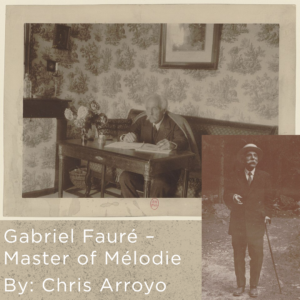 Born in the southwest of France to a family that wasn’t particularly musical, Gabriel Fauré never intended to become one of the pre-eminent voices of French music. He wrote very few large-scale works, among them two operas, a handful of orchestral pieces and a Requiem. However, the bulk of his oeuvre (as well as the foundation of both his rise and longevity) was his chamber music, piano works and, above all, his music for voice and piano. Fauré’s grasp of French mélodie redefined and solidified France’s place in the world of art song and earned him the title “Master of Mélodie”.
Around the height of the Romantic era, German lieder was quickly gaining widespread popularity, with other countries scrambling in its wake to produce something similar. French art song, though present, was far more dramatic, declamatory, and lush than it was after Fauré’s influence. (Henri Duparc’s L’invatation au voyage comes to mind.) Fauré, being what we call a “top-down” composer – meaning he prioritized melody and harmony over the rhythmic drive of the music – leaned into his impressionistic tendencies, pulling back on the almost over-indulgent density of more traditional French styles. (He famously had a heated rivalry with Claude Debussy over this very distinction.) He made a point of elevating the pianist to more than just an accompaniment, and into an integrated part of the ensemble with the vocal line. The two parts would weave together and create a whole picture, rather than being functionally individual entities.
Harmonically, Fauré favored a more intimate and subtle approach, allowing harmony to weave into more daring worlds than his predecessors, while still living in foundational musical techniques. He pushed the envelope while still honoring the letter it was meant to carry. As he grew older he developed serious hearing loss, which pushed his harmonic language even further into the 20th century sounds – his final song cycle, L’horizon chimérique, is a shining example of this. We also hear this harmonic legacy through the works of many of his students, including Maurice Ravel, Georges Enescu, and the student who went on to teach seemingly all of our favorite 20th century composers, Nadia Boulanger.
Ultimately, as a quintessential impressionistic composer, Fauré set poetry in a way that allowed the honesty and humanity of the written word to be elevated and centered in the music, rather than as an afterthought. All parts of the music work together to paint a single portrait. Every note, every word, every accidental was chosen with intention. As a voice teacher, I will often give my students at least one piece by Fauré. On the surface it’s quite simple and easy to learn. It’s when you begin to notice the small things, the subtleties, that you begin to understand the complexity and genius of the “Master of mélodie.”