The Romantic Period
The Romantic Period

Music History Moment
The Romantic Era
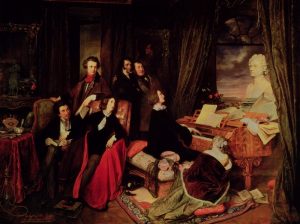
Composers of the early nineteenth century were the first, and virtually only, ones to identify themselves by the term we have come to call the period: Romantic. The term derives from literary movements of the time, and has come to be associated with, not only love and romance, but individual feeling, revolution, extolling the past, and the supernatural. Despairing of how to follow Beethoven, Romantic composers turned to both shorter forms, like the German Lied, or art song, “Songs without words,” and other character pieces for piano; and to more grandiose forms, such as the concert overture, symphonic poem, and programmatic symphonies. Heightened, intense expression and the cultivation of a unique, personal style were hallmarks of the music of the period. It was a time when the cult of the virtuoso performer and conductor arose, with the likes of Paganini on the violin, Liszt at the piano, and Berlioz on the podium. In Italy, composers of opera combined the fluid, melodic style of Mozart with a Baroque type of vocal technique, resulting in the bel canto operas of Rossini, Bellini, and Donizetti. German opera composers turned to the supernatural, with the most famous examples being Weber’s Der Freischütz and Marschner’s Der Vampyr. Schubert composed over 600 songs, as well as numerous works in virtually every genre known at the time: symphonies, sonatas, string quartets, and operas. Chopin, Schumann, and Liszt all wrote numerous examples of short piano pieces, while Berlioz concentrated on more grandiose forms. Mendelssohn and others wrote a number of concert overtures, while Liszt is credited with inventing the symphonic poem, a single movement musical work drawing inspiration from art, literature, or nature. This was also the period that saw the rise of the concert hall, and composers, now without the support of royalty or rich patrons, had to fend for themselves and produce music that the newly cultivated music-going public would pay to hear.
Major Composers
- Carl Maria von Weber (1786-1826) German operas, concertos, piano music
- Gioachino Rossini (1792-1868) Italian and French operas
- Franz Schubert (1797-1828) Symphonies, piano music, chamber music, songs
- Gaetano Donizetti (1797-1848) Operas
- Vincenzo Bellini (1801-1835) Operas
- Hector Berlioz (1803-1869) Program symphonies, overtures, choral works, songs
- Felix Mendelssohn (1809-1847) Program symphonies, overtures, chamber music, piano music
- Frédéric Chopin (1810-1849) Piano music
- Robert Schumann (1810-1856) Symphonies, piano music, chamber music, songs
- Franz Liszt (1811-1886) Symphonic poems, piano music, program symphonies