The Rossini Crescendo
The Rossini Crescendo

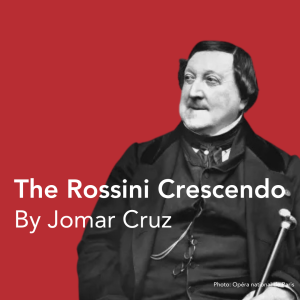 Born in Pesaro, Italy in 1792, Gioachino Rossini is one of Italy’s most well-known composers and one of the foremost composers of opera. His first opera was commissioned when he was just 18 years old, and over the next two years he composed seven such works. La pietra del paragone, or “The Touchstone,” was completed during this fruitful period, and the first work in which he implemented a musical device that he would use feverishly in many of his operas: the Rossini crescendo.
A crescendo in Classical music is defined as a gradual increase in sound. Some iconic examples are the climax of “In the Hall of the Mountain King” from Edvard Grieg’s Peer Gynt Suite, or Maurice Ravel’s Bolero, which gets louder as the piece goes on. Rossini, eventually given the nickname “Monsieur Crescendo,” put a special spin on it. A Rossini crescendo starts with a few instruments repeating a fast-moving melodic line over a few bars of music. Then more instruments join in, increasing the volume until the entire orchestra is involved in a musical frenzy. It creates an auditory experience that is exciting to listen to and which makes his comedic operas even more humorous.
The Rossini crescendo’s versatility is clear through the roles it can play in enhancing what is taking place onstage. Rossini often used this technique to build anticipation during the introduction of new characters and scenes, and to give mundane scenes and important moments more dramatic emphasis. For example, although Figaro’s barbershop in The Barber of Seville is quite plain, the intensity and grandness of the music when it is described by the barber creates a mismatch that is comical. In La Cenerentola, the prince’s valet, Dandini, excitedly describes Cinderella’s approach at the ball, and the orchestra matches his energy with a Rossini crescendo at the same time. The energy builds until the splendidly dressed Cinderella arrives on stage.
This is just one device Rossini was well known for using, and there are more he implemented to further entertain audiences who demanded a thrill of the senses. These recognizable techniques give insight as to how Rossini set the trend for opera composition in the latter half of the 19th century, and why his music is as timeless as it is today.