"Nannerl" Mozart
“Nannerl” Mozart

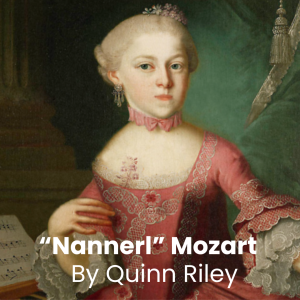 She was considered to be one of the finest pianists and child prodigies in Europe; that is until her younger brother Wolfgang Amadeus came along. Born in July of 1751, Maria Anna Walburga Ignatia “Marianne” Mozart, called “Nannerl” by her family and friends, was the fourth child and first surviving infant of seven children born to Leopold and Anna Maria Mozart. When Nannerl was around seven years old, her father, a professional musician and composer, began to teach her the harpsichord. Nannerl took to the instrument quickly, as did her only surviving sibling, two year old Wolfgang, who often sat beside her at the harpsichord or pianoforte while she played.
When she was about nine years old, Leopold took both Nannerl and Wolfgang on tours of many European cities, including Vienna, Paris, and Munich, where they played private concerts for the courts and nobility, and public concerts for general audiences. Nannerl and Wolfgang toured for more than three years, covering several thousand miles by horse-drawn carriage, stopping in 88 cities and performing for many thousands of people. During their touring, Nannerl sometimes received top billing and was even considered a better musician than her younger brother. When Nannerl was twelve, her father wrote in a letter, “What it all amounts to is this, that my little girl, although she is only 12 years old, is one of the most skillful players in Europe.” However, none of these lauds helped Nannerl in selling the works she wrote. Yes, she wrote her own music, but none of Nannerl’s pieces were ever published.
Just how far Nannerl could have gone as a musician and composer, we will never know. In 1769, when she was 18, an age at which she was expected to marry, Leopold ended his daughter’s touring days. Be that as it may, Nannerl did not find the right man until 1784 when she was thirty-three and married a wealthy widower twice her age named Baron Johann Baptist von Berchtold zu Sonnenburg. During their seventeen year marriage, Nannerl helped raise her husband’s five children from a previous marriage, and also had three children of her own. Because of her husband’s wealth, Nannerl was allowed to pursue her musical interests, playing the keyboard for up to several hours a day.
Eventually, due to their busy and different lives, Nannerl and Wolfgang drifted apart and saw each other very little. In fact, the last time Nannerl saw Wolfgang was in 1788; three years before his death.
Nannerl’s health declined in her old age, and by 1825 she was blind, languid, feeble, and nearly speechless. Unlike her brother, who died early and penniless, Nannerl died in October of 1829, a wealthy and elderly woman.